Product
Contact Us
- Mr. Zhang 13961458166
- 0519-88908166
- xldry8166@163.com
- No. 67, Zhujia Bridge, Sheng'an Village, Zhenglu Town, Tianning, Changzhou, Jiangsu


- Product Details
- Photo Collection
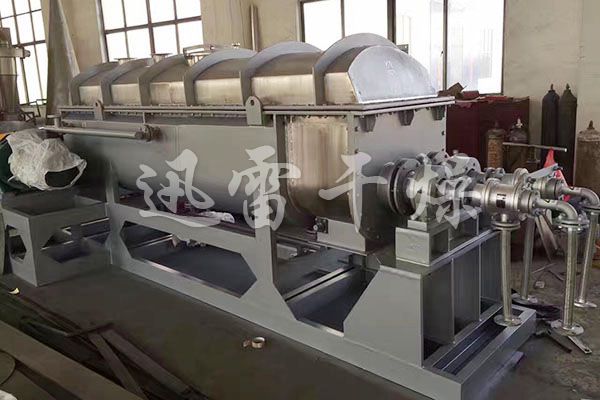
The specialized biochemical sludge dryer is capable of drying biochemical sludge with low energy consumption and operating costs, achieving automation in biochemical sludge treatment.
Biochemical sludge drying method:
Thermal drying technology is used in the treatment of biochemical sludge. According to whether the heat medium is in contact with the sludge, the current sludge thermal drying technology can be divided into three categories: direct thermal drying technology, indirect thermal drying technology, and direct indirect combined drying technology.
Direct heat drying technology, also known as convective heat drying technology. Convective heat drying is the process of removing moisture from the surface of sludge using hot air. The efficiency of drying depends on two factors: air operating conditions (steady point, relative humidity, speed) and the structure and characteristics of the sludge itself. During the manipulation process, the heat medium (such as hot air, gas, or steam) comes into direct contact with the sludge. The heat medium flows through the sludge layer at low speed, absorbing moisture from the sludge. The treated dry sludge needs to be separated from the heat medium. Part of the exhaust gas is returned to the original system through the heat recovery system for reuse, while the remaining part is discharged after harmless treatment. This technology has high heat transfer efficiency and evaporation rate, which can increase the solid content of sludge from 25% to 85% to 95% However, due to direct contact with sludge, the heat medium will be contaminated, and the discharged wastewater and water vapor must undergo harmless treatment before being discharged; At the same time, the separation of heat medium and dry sludge poses certain difficulties for manipulation and treatment. Paddle dryer is currently one of the effective equipment for the drying treatment of biochemical sludge.
Working principle of biochemical sludge dryer:
Dry mud freely falls into the rotary incineration kiln from the outlet of the double blade dryer, and is incinerated in the kiln under the rotation of the kiln body and the pulling force of the induced draft fan. The thermal energy for initial kiln incineration (ignition stage) is supplied by the natural gas burner set at the rotary kiln head, and the oxygen for incineration is also supplied by the adjustable air outlet set at the kiln head. After the dry mud is incinerated normally in the kiln and the heating is balanced (kiln temperature 850-1000C ° C), the natural gas burner can be gradually turned off. After incineration, dry mud forms dry slag, with more than 80% of its coarser particles settling in the secondary combustion and settling chamber, and less than 20% of its finer and coarser particles continuing to rise with hot air. The settled particles enter the chain conveyor through the discharge outlet at the bottom of the secondary combustion and settling chamber, and are then transported to the dry slag storage bin by a vertical elevator for comprehensive utilization by external transportation.
Properties of Biochemical Sludge:
Biochemical sludge is an emulsion system composed of microorganisms, petroleum, colloids, asphaltene, sediment, inorganic flocs, organic flocs, as well as water and other organic and inorganic substances firmly bonded together. It contains substances such as benzene derivatives, phenols, anthracene, pyrene, etc., which have a foul odor and toxicity, causing great impact on the environment. They have a strong affinity for water. Poor dehydration performance. Direct dehydration will require a large amount of dehydration equipment and result in significant economic waste. In addition, the biochemical sludge from refinery wastewater has a high moisture content, a large volume, and fine colloidal particles in the sludge. Difficult to settle, it needs to be concentrated, medicated, and mechanically dehydrated. After dehydration, the moisture content of the sludge cake is reduced to 60% to 85%, making the sludge undergo volume reduction treatment for easy transportation and ultimate disposal.
As can be seen from the experiment. Inorganic coagulants and APAM can produce flocculation phenomenon, but the formed flocs are small, slow to separate, and have poor flocculation effect, which is not conducive to subsequent dehydration treatment. CPAM has good flocculation effect and fast separation, making it an ideal flocculant for the treatment of biochemical sludge in refinery wastewater.
The above content is compiled based on the problems encountered by students in their actual work, for reference only. If there are any problems, please communicate and correct them in a timely manner.
- BACK
- Previous:Domestic sewage sludge dryer
- Next:Textile sludge dryer
Experts analyze that the Chinese rotar···
26.01.28Working principle of purifying hot air···
26.01.28Spray drying is a method of systematic···
26.01.28Troubleshooting and equipment advantag···
26.01.28How to choose a suitable hot air circu···
26.01.28Methods of spray drying and comparison···
26.01.28Internal structure and atomization pro···
26.01.28Granulation function of horizontal spr···
26.01.28New Trends in the Integration of Dryin···
26.01.28Comparison and difference between ultr···
26.01.28