Product
Contact Us
- Mr. Zhang 13961458166
- 0519-88908166
- xldry8166@163.com
- No. 67, Zhujia Bridge, Sheng'an Village, Zhenglu Town, Tianning, Changzhou, Jiangsu


- Product Details
- Photo Collection
Overview:
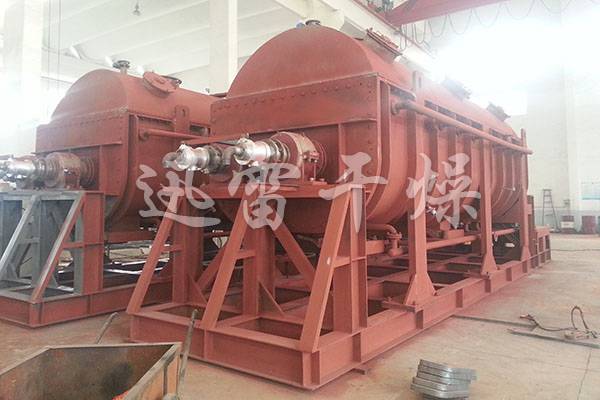
The specialized municipal sludge dryer has the characteristics of low energy consumption and high efficiency. The characteristics of heat transfer, cooling, and stirring of the equipment enable it to perform the following unit operations: calcination (low temperature), cooling, drying (solvent recovery), heating (melting), reaction, and sterilization. The stirring blade is also a heat transfer surface, which increases the heat transfer area per unit effective volume and shortens the processing time. The wedge-shaped blade heat transfer surface also has self-cleaning function. The compression expansion mixing function ensures uniform mixing of materials. The material forms an axis; Piston flow; In the axial range of motion, the temperature, humidity, and mixing gradient of the material are very small.
Using thermal oil as the heat medium, the blade dryer can complete low-temperature calcination work. For example, calcium sulfate dihydrate (Ca2SO4 · 2H2O) is calcined and converted into calcium sulfate hemihydrate (Ca2SO4 · 1/2H2O). Sodium bicarbonate (NaHCO3) is converted into pure alkali (Na2CO3) through calcination.
Cooling media such as water, cooling salt water, etc. can be used for cooling. For example, the blade type cooling alkali machine used in the soda ash industry replaces the old-fashioned air-cooled cooling alkali machine, saving energy and exhaust gas treatment equipment, reducing operating costs, and can also be used for cooling titanium dioxide, nickel iron alloy powder, and various granular materials. The material can be cooled from 1000 ℃ to less than 40 ℃ in a single machine.
Drying, the main function of the equipment, does not use hot air, making solvent recovery, energy consumption, and environmental control in an ideal state that is easy to handle. It is particularly suitable for solvents that need to be recycled, flammable and easily oxidizable heat sensitive materials. It has been widely used in the fine chemical, petrochemical, and dye industries.
The uniformity of temperature, humidity, and mixing degree within the axial range allows the equipment to be used for heating or melting, or for some solid material reactions. It has been successfully used in the compound fertilizer and modified starch industries. Paddle dryers can be used to sterilize food and flour. The large heating area within the effective volume of the unit quickly heats the material to the sterilization temperature, avoiding prolonged heating and changing the quality of the material.
Working principle of municipal sludge dryer:
The municipal sludge dryer is a horizontal mixing type dryer mainly based on heat conduction. Its main structure is a W-shaped shell with a jacket, which is equipped with paired hollow low-speed rotating hollow shafts. Several mixing hollow blades are welded to the shafts, and both the jacket and the hollow mixing blades are filled with heat carriers. The two heating surfaces heat the material simultaneously. Therefore, this type of dryer has a more prominent heat transfer rate than general conduction dryers. As needed, this type of dryer can be designed as a double axis or multi axis dryer. Hot air is usually sent in from the middle of the dryer, passes through the surface of the material layer in a stirred state, and is discharged from the other side.. The heating medium can be steam, hot water, or high-temperature thermal oil.
Characteristics of Municipal Sludge:
Municipal sludge is a solid-liquid mixture formed by live cells of bacteria and fungi, their formed microbial aggregates, and water. The reason for its difficulty in dewatering is due to the composition of water. It is generally believed that there are four forms of water binding:
(1) Gap water (free water) is a type of gap water surrounded by large and small sludge, which does not directly combine with solids and can be separated by gravity. This part of the water accounts for about 70% of the total water content.
(2) Capillary water around highly dense fine sludge solid particles forms the following types of water due to capillary phenomena: wedge-shaped capillary bound water, which combines into wedge-shaped capillary water at the contact surface of particles due to capillary pressure; Gap capillary binding water, capillary water that fills the space between solids; Fracture capillary binding water; Capillary water filled in the cracks of the solid itself. To remove bound water under capillary pressure, it is only necessary to apply a force opposite to the resultant force of capillary surface tension. Utilize centrifugal force (centrifuge), negative pressure (vacuum filter), electroosmotic force or thermal osmotic force, etc. This part of water accounts for about 20% of the total water content.
(3) Adsorption of water requires molecular forces to tightly adsorb with solids, and cannot be removed by centrifugation or other mechanical forces.
(4) Internal water gap water, capillary bound water, and surface adsorbed water are all external liquids. A portion of the water in sludge is enclosed in the cell membrane of microorganisms, such as cell fluid. This internal water is tightly bound to solids, and to remove it, it is necessary to destroy the cell membrane through biodegradation (aerobic oxidation, composting, anaerobic oxidation), or measures such as high temperature and freezing.
The first two are easy to remove by mechanical force, while the latter two are difficult, resulting in difficulty in sludge dewatering and high energy consumption.
- BACK
- Previous:Electroplating sludge dryer
- Next:Municipal sludge dryer
Experts analyze that the Chinese rotar···
26.01.28Working principle of purifying hot air···
26.01.28Spray drying is a method of systematic···
26.01.28Troubleshooting and equipment advantag···
26.01.28How to choose a suitable hot air circu···
26.01.28Methods of spray drying and comparison···
26.01.28Internal structure and atomization pro···
26.01.28Granulation function of horizontal spr···
26.01.28New Trends in the Integration of Dryin···
26.01.28Comparison and difference between ultr···
26.01.28